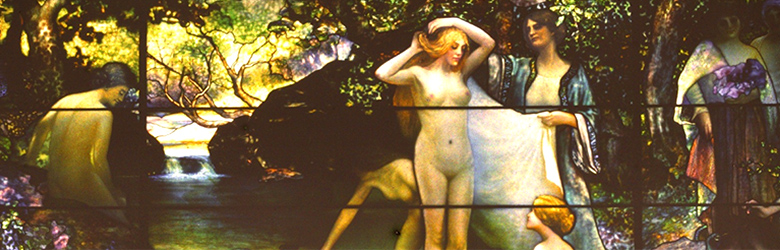

of Louis Comfort Tiffany
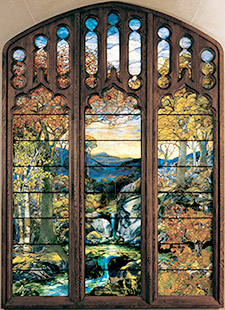
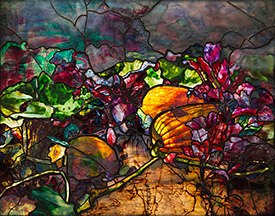
Louis Comfort Tiffany, Autumn Landscape, 1923. The Metropolitan Museum, Engelhard Court.
The annals of history are replete with lost masterpieces over the centuries, from The Colossus of Rhodes, to Leonardo's Sforza Statue destroyed by invading French troops, to the missing 75% of Rembrandt's Claudius Civilis that was cut away. But one artist was especially victim to the vagaries of taste, fortune and circumstance: Louis Comfort Tiffany. Included here are just a few of the many amazing things made by Tiffany lost to time over the years.
To those visitors who enjoy seeing Tiffany's Autumn Landscape at The Metropolitan Museum, keep in mind that the fates just happened to prove kind in that particular instance. For, unlike many a Tiffany window that would be destroyed or lost, this particular one survived, after the original commissioning client died. The intended installation in his private home was cancelled, resulting in a lucky sale to The Met, where it can be found today in the Engelhard Court. And as for the Engelhard Court itself, whether in its newest renovation, or in previous incarnations, incredible as it is, do remember it is only a small glimpse of what Tiffany's Central Hall was like, as we see below.
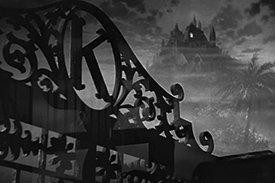
The gated entrance to Charles Foster Kane's Xanadu. Film still from Citizen Kane, 1941 by Orson Welles.

"The Loot of the World" - acquisitions of Xanadu. Film still from Citizen Kane, 1941.
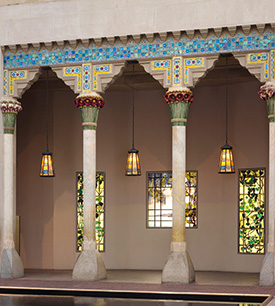
Remains of the Loggia of Laurelton Hall, ca. 1905, installed in The Metropolitan Museum's Engelhard Court, NY.
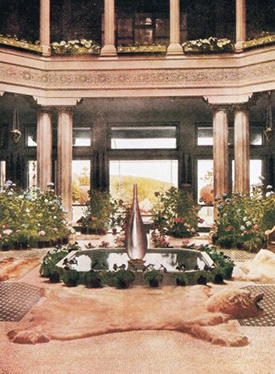
The Central Hall, Courtyard & Fountain.
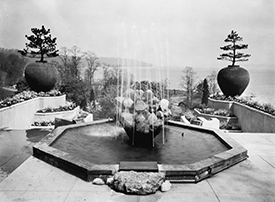
Fountain overlooking the Harbor.
1. The Real Xanadu: Laurelton Hall
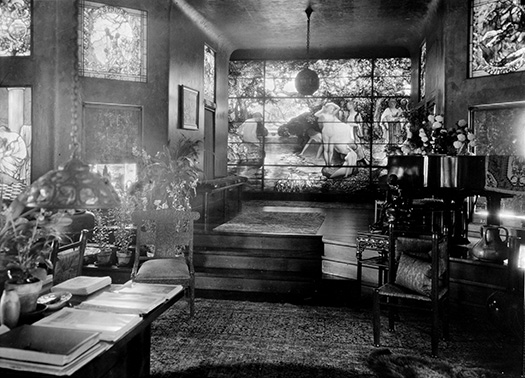
Interior of Laurelton Hall, Living Room, ca. 1925.
In Citizen Kane (1941), Charles Foster Kane has a palatial private mountain estate called Xanadu. Described as containing the "Loot of the World" it had the art collections of 10 museums, a zoo, Venetian canal, and sprawling gardens. But it turns out that there might have existed a real life version in America: Tiffany's Laurelton Hall.
Laurelton was a complete living artwork, with its own railway station, private beach, greenhouses, farm and chapel. Chock-a-block with the choicest artwork literally dripping from floor to ceiling, Laurelton Hall was Louis Comfort Tiffany's dream manse that he built in Laurel Hollow, Long Island. A 65+ room mansion complex on 600+ acres of land, the interiors were decorated with thousands of unique objects from around the world, including the very best works Tiffany himself handpicked from Tiffany Studios, works that had even won him international fame and gold medals. A visitor once wrote in the guestbook: “Arabian night’s dreams vanish, at Laurelton a phantom has become reality, eternal.”
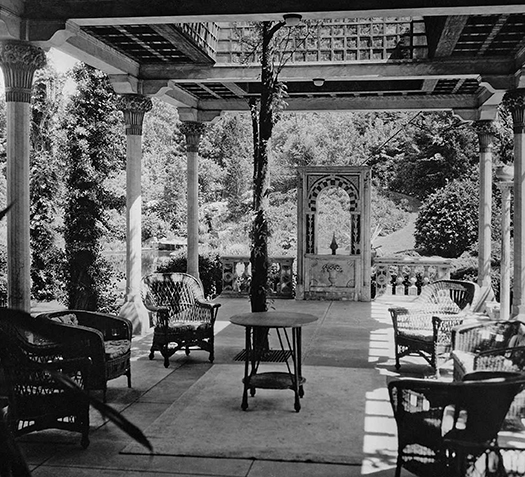
Where art & nature commune: The original Daffodil Terrace.
No doubt, that if it still stood today, Laurelton would be a historic site and a permanent museum: the ultimate legacy of Tiffany's ouvre. But the vagaries of fashionability would not be so kind, unfortunately. In its day, Laurelton became sort of the ultimate white elephant, a monument to supposedly another time's kind of artwork, considered demode and passe.
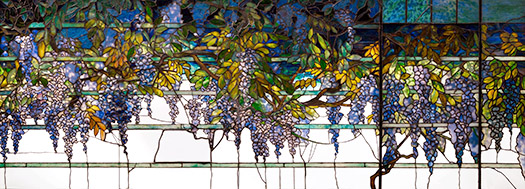
Wisteria Transom Panel, c. 1910–20, From the Dining Room of Laurelton Hall, Long Island, New York. Wisteria. Charles Hosmer Morse Museum, FL.
Estimated to have cost some 2 million dollars to construct in 1905, and perhaps worth some 13 million dollars years later, the manse fell into disrepair in the years after Tiffany's death, and was eventually sold for an unbelievable price of only $10,000. Collector Vito D'Agostino was offered Laurelton Hall at this price, and dreamt of its purchase, but even with every penny of his life savings he could not afford the $2,000 in yearly taxes it cost to keep - the sum total of all his earnings as a Brooklyn schoolteacher. Much like at the end of Citizen Kane, when visitors wondered what to do with the place and all its innumerable crates of artwork, quite literally: no one wanted it.
Laurelton Hall was destroyed by a fire in 1957.

Color Autochrome, ca. 1914 of The Bathers by Louis Comfort Tiffany, Metropolitan Museum, NY. (destroyed).
Only one of the many masterpieces installed in Laurelton Hall, firefighters actually smashed through The Bathers to gain access during the fire that burnt Laurelton Hall down to the ground in 1957. This amazing early color photograph dated in the early teens hints at what must have been an incredible palette.
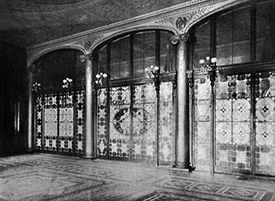
Entrance Hall of The White House, 1882.

Peter Waddell, The Grand Illumination, Sunset of the Gaslight Age, 1891. oil on canvas, White House Historical Association.
One of the most legendary objects in The White House's history is the colored glass screen by Tiffany that was located in the Entrance Hall. Commissioned by President Chester A. Arthur in 1885, it was removed on the orders of new President Teddy Roosevelt in 1902, who supposedly wanted it "smashed" into little pieces. Rumor has it that the tremendous lost screen was instead removed, auctioned off for $275, and eventually installed into the Belvedere Hotel in Maryland, which burnt to the ground in 1923. Some historians speculate President Roosevelt's motivations in removing a national treasure might date back to his personal animosity to Tiffany, possibly inspired by the bitter litigation and dispute with the town of Oyster Bay during Tiffany's acquisition of the property of Laurelton Hall, originally public picnic grounds and an old hotel of the same name.

Computer reconstruction of The Blue Room in The White House, circa 1886, Nest magazine, 2000.
Tiffany also redecorated and designed the Blue Room, the East Room and the Red Room in the White House at the time. The Blue Room, or Robin's Egg Room -- as it was sometimes called for its egg blue color - had ornaments in a hand-pressed paper, touched out in ivory, as well as Tiffany's trademark lighting fixtures.
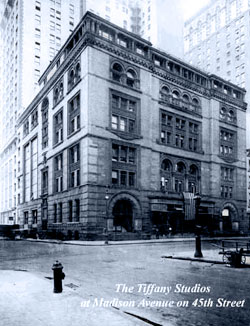
Tiffany Studios at Madison Ave & 45th Street, NY.
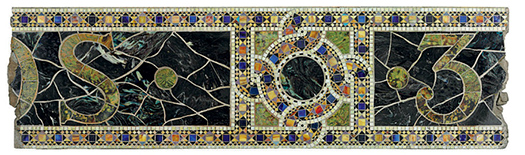
Favrile glass over concrete: Fragment of the mosaic sign from The Tiffany Studios building, 347-355 Madison Avenue, NY.
If Laurelton Hall might be the equivalent to something like Orson Welles' Xanadu, then Tiffany Studios in today's light might be almost equivalent to something like Edison's studio, or perhaps Leonardo's workshop, filled to the rafters with the inventory of decades of the finest handmade glass objects of all time.
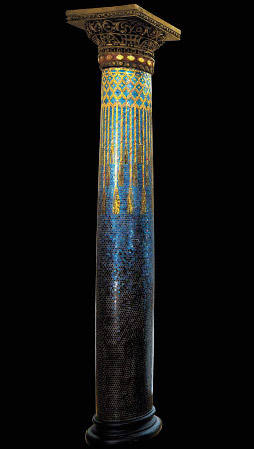
Favrile glass mosaic column, ca. 1905, Metropolitan Museum. One of a pair of mosaic columns originally flanking the entrance to Tiffany Studios.
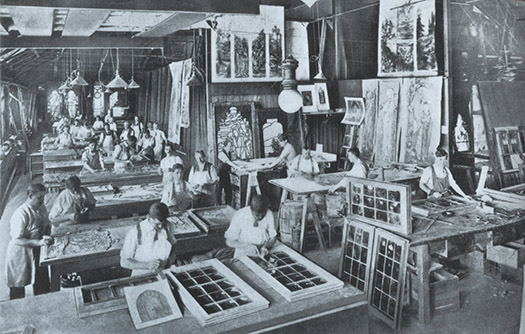
Workmen at Tiffany Studios.
A five story building including workrooms and showrooms, Tiffany Studios held an unparalleled collection of original designs, samples, Favrile glass sheets and more, employing some of the finest workmen, designers, craftsmen and chemists. To this day, Favrile glass and works the likes of Tiffany Studios still cannot be authentically equaled, even with today's technology.
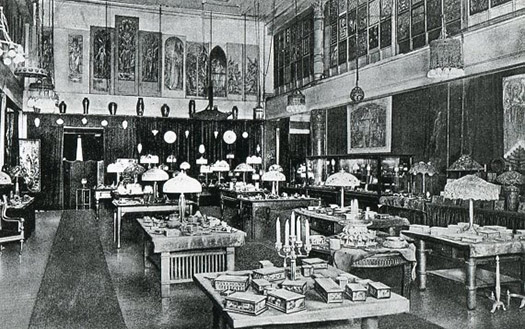
Tiffany Studios showroom, ca. 1913.
Tiffany Studios was liquidated in 1933. More on this, and Vito D'Agostino's rescue of works from Tiffany Studios, to come.
Additional masterworks of Tiffany's can be found in the "Masterworks of Tiffany" gallery at the Empire of Glass website:
www.EmpireofGlass.com